Floral Skull Patch
A Bold, Unexpected Statement That Stops Craft Fair Shoppers in Their Tracks
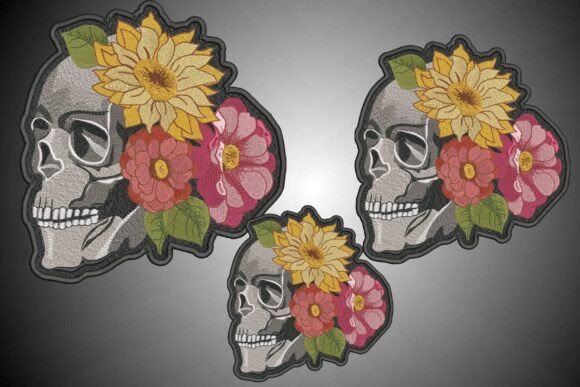
Let’s be real: at a crowded handmade market, subtlety rarely wins. The Floral Skull Patch doesn’t whisper—it leans into the booth with confident contrast. It’s bold, yes—but not aggressive. Modern, but not cold. Playful, but never juvenile. That balance of edgy and elegant is exactly why this machine embroidery design stands out on tote bags, aprons, and even tea towel sets. It reads as premium at first glance—not because it’s fussy, but because the composition feels intentional: skull structure grounded by organic floral flow, all wrapped in that clean stitched border that signals “patch,” not just decoration.
Where It Shines (and Where It Needs Extra Care)
This isn’t a one-size-fits-all embroidery file. Its strength lies in *curated placement*, not blanket application. Here’s how it performs across common craft fair products:
- Tote bag design: Ideal as a centered chest-height focal point on natural canvas or heavyweight cotton. The border frames it like art—no extra framing needed. Customers instantly read it as handmade, not printed.
- Apron embroidery: Works beautifully on the lower pocket or upper bib—especially on denim or linen blends. The floral detail adds softness to utilitarian wear, making it a favorite among foodie makers and boutique café owners.
- Tea towel embroidery: Use it small (3.5"–4") on the corner or hem. Avoid dense terry cloth—weave texture can swallow fine petal lines. Stick to smooth cotton or linen for crispness.
- Embroidered patch: This is where the Floral Skull Patch truly earns its name. Backed with heat-seal or sew-on adhesive, it becomes a versatile product itself—sold loose or pre-applied to pouches, caps, or pillow covers.
- Caps and curved surfaces: Proceed with caution. The skull’s symmetry and floral curves demand precise hooping and light stabilizer. Test on scrap first—dense stitch areas near the eye sockets may pucker on stiff caps without proper tension control.
- Fabric pouches & pillow covers: Excellent on medium-weight quilting cotton or linen-cotton blends. The border gives visual weight, so even small versions (2.75") retain impact without looking lost.
What Makes It Sell—Beyond the Aesthetic
As an embroidery designer prepping for a weekend craft fair, I don’t just ask, “Does it look good?” I ask, “Does it convert?” The Floral Skull Patch converts because it bridges audiences: goth-adjacent shoppers love the skull; botanical lovers gravitate to the florals; modern farmhouse fans appreciate the clean border and balanced negative space. It’s inclusive edge—not niche exclusion.
It photographs exceptionally well for Etsy listings and Instagram reels. The contrast between dark skull outlines and bright thread colors pops on light fabric, and the stitched border gives depth that flat prints can’t match. That visual richness translates directly to perceived value: customers pay more for finished product when they see intentional stitch density and thoughtful thread color layering.
For booth display strength? Mount one on a denim jacket, another on a folded linen tea towel, and a third as a standalone iron-on patch beside a small embroidered pouch. That triad tells a story: versatility, craftsmanship, and cohesive brand energy—even if you’re a solo small shop product maker.
Production Reality Check: What You Must Test Before Batch Runs
This isn’t a “load-and-go” embroidery file. To protect your time, thread budget, and reputation for quality, run these checks before cutting fabric:
- Test on scrap fabric—same weight, same weave, same dye lot as your final goods. Thread contrast shifts dramatically on black vs. oat vs. sage linen.
- Review stitch density in the floral centers and along the skull’s contours. High density + thick fabric = stiffness and potential puckering. Adjust underlay or reduce density if needed.
- Confirm hoop size and stabilizer pairing. Lightweight tear-away works for smooth cottons; cut-away or medium-weight fusible is safer for textured towels or stretchy knits.
- Check spacing between elements. Tiny flower stems or delicate leaves must clear adjacent stitches—even at 80% scale. If details blur or merge, resize upward or simplify manually.
- Create at least one real mockup—not just a printable mockup. See how it drapes, how light hits the thread sheen, how it feels in hand. That tactile truth is what builds buyer trust.
- Verify commercial licensing. As a digital embroidery file, the Floral Skull Patch must be cleared for resale of finished products. Don’t assume—check the license terms before listing on Etsy or packing market bags.
Final Designer Notes: Why This Design Fits the Work Category—and Your Business
This is embroidery as intentional work—not decoration as afterthought. The Floral Skull Patch belongs in the Work category because it demands attention to technique, material science, and customer psychology. It rewards precision and punishes rushed execution. But get it right, and it becomes your quiet bestseller: the item people point to, snap photos of, and return for in different colorways.
It strengthens brand consistency when used across multiple product types—say, matching aprons and tea towels for a kitchen boutique line—or as a signature accent on limited-run pouches. For the Etsy seller juggling 12 design assets, it’s a high-margin anchor piece. For the Cricut crafter branching into machine embroidery, it’s a confident first step into dimensional, textural storytelling.
In short: the Floral Skull Patch isn’t just another embroidery file. It’s a conversation starter, a quality signal, and a smart craft fair product—when treated with the care its detail deserves.